Last Updated: August 2026
Shipping from China to Pakistan is one of the most important trade routes for Pakistani importers, manufacturers, wholesalers, retailers, and e-commerce businesses. But finding a cheap freight rate is only one part of importing successfully.
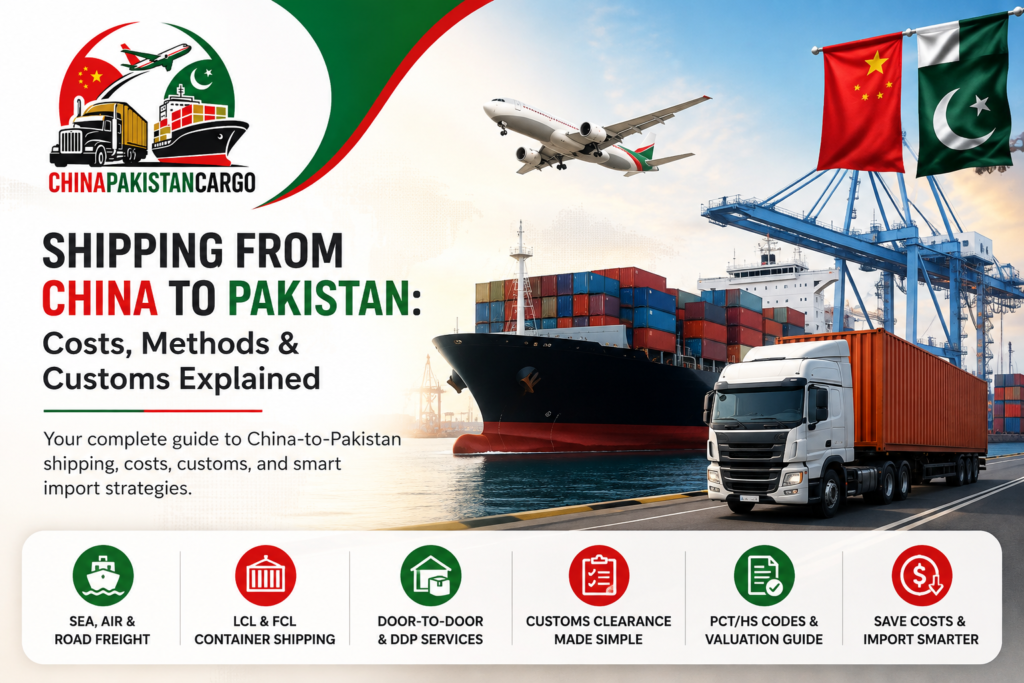
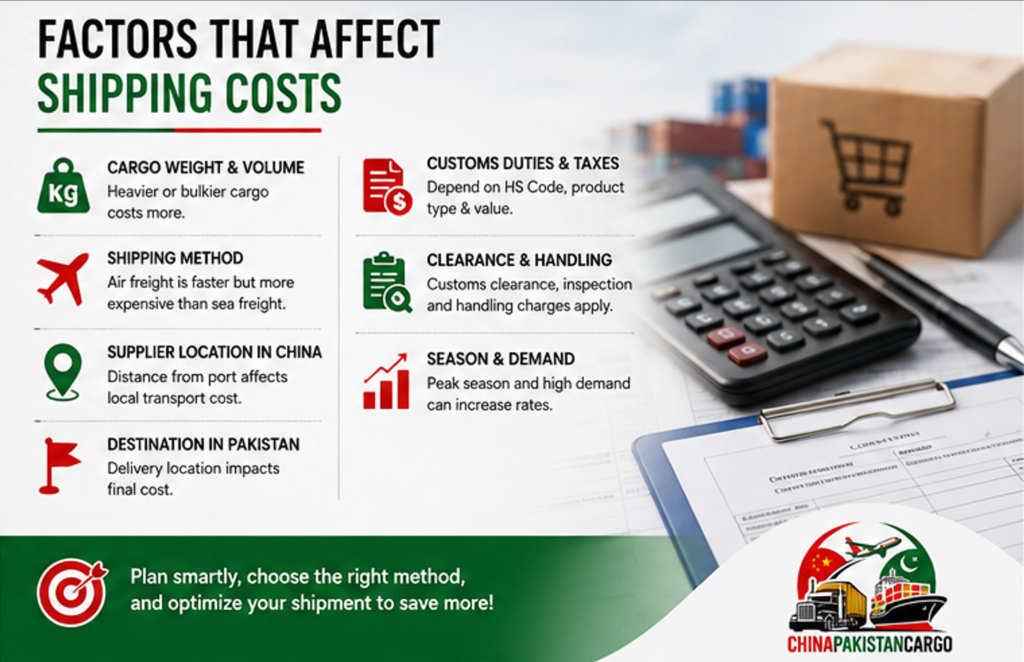
The real cost of shipping from China to Pakistan depends on your cargo weight and volume, shipping method, supplier location, destination in Pakistan, customs value, PCT/HS code, applicable duties and taxes, clearance charges, and final delivery.
Whether you are sending a few cartons, several cubic metres of commercial goods, machinery, electronics, raw materials, or a full container, choosing the right Pakistan cargo services can significantly affect your landed cost.
In this guide, China Pakistan Cargo explains:
- China-to-Pakistan shipping costs
- Air vs sea vs road freight
- LCL and FCL container shipping
- Door-to-door and DDP cargo
- Pakistan Customs clearance
- PCT/HS codes
- Customs valuation and FBR valuation rulings
- Required shipping documents
- China-Pakistan FTA considerations
- Ways to reduce your total landed cost
If you already know your shipment details, you can request a China-to-Pakistan cargo quote.
China to Pakistan Shipping at a Glance
| Shipping Method | Typical Transit Time* | Best For | Main Pricing Factor |
|---|---|---|---|
| Air Freight | Approx. 3–10 days | Urgent, lightweight and high-value cargo | Chargeable weight |
| Sea Freight – LCL | Approx. 20–35+ days | Small/medium commercial shipments | CBM/weight |
| Sea Freight – FCL | Approx. 20–35+ days | Large-volume shipments | Container |
| Road Freight | Route-dependent | Suitable overland commercial cargo | Weight/volume/load |
| Door-to-Door / DDP | Depends on transport mode | Importers wanting managed logistics | Agreed service scope |
*Transit times are estimates rather than guarantees. Origin city, carrier schedules, customs inspection, congestion, weather, holidays, documentation and final destination can all affect delivery time.
The cheapest shipping method is therefore not necessarily the most economical overall.
A better comparison considers:
Freight Cost + Customs + Clearance + Handling + Final Delivery + Transit Time + Inventory Impact
How Does Shipping from China to Pakistan Work?
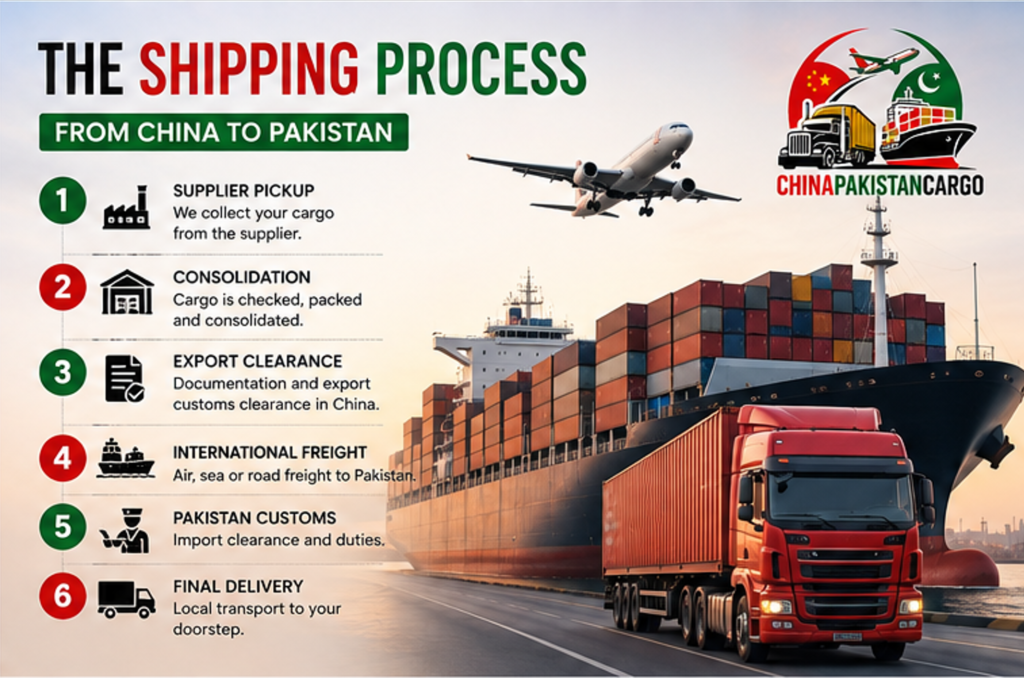
A typical commercial shipment follows this route:
Chinese Supplier → Pickup → China Warehouse → Consolidation → Export Clearance → International Freight → Pakistan Customs → Local Transport → Final Delivery
Depending on the service you choose, you can manage these stages separately or use one logistics provider to coordinate the complete shipment.
A professional cargo to Pakistan service may handle everything from supplier pickup in China through customs clearance and final delivery in Pakistan.
China Pakistan Cargo offers door-to-door cargo from China to Pakistan for businesses that prefer an end-to-end logistics solution.
Step 1: Supplier Pickup and Cargo Consolidation in China
Your shipment normally begins at the supplier’s factory or warehouse.
Major Chinese sourcing and manufacturing areas include:
- Guangzhou
- Shenzhen
- Yiwu
- Foshan
- Dongguan
- Ningbo
- Shanghai
- Qingdao
- Zhejiang
- Jiangsu
If you purchase products from multiple factories, shipping each supplier’s goods separately can increase logistics costs.
If you need help in sourcing, you can hire an agent from chinawholesalehub.com
Consolidating Multiple Chinese Suppliers
Instead, your freight forwarder can collect goods from several suppliers and combine them at a warehouse before sending the consolidated cargo to Pakistan.
For example:
Supplier A: 2 CBM
Supplier B: 1.5 CBM
Supplier C: 3 CBM
Total consolidated shipment:
6.5 CBM
This can be more efficient than arranging three independent international shipments.
Cargo consolidation is particularly useful for:
- Wholesalers
- Amazon and e-commerce sellers
- Retailers
- Machinery importers
- Manufacturers
- Trading companies
- Businesses sourcing mixed products from Yiwu or Guangzhou
Step 2: Cargo Inspection, Packing, Weight and CBM
Before international transportation, the cargo should be measured accurately.
Important shipment information includes:
- Product description
- Number of cartons
- Gross weight
- Net weight
- Carton dimensions
- Total CBM
- Packaging type
- Commercial value
- Fragile or special-handling requirements
These figures determine which shipping method is most economical.
Air freight is generally affected by chargeable weight, while LCL sea freight is heavily influenced by CBM and cargo density.
Incorrect carton measurements can therefore result in an inaccurate freight quotation.
How Much Does Shipping from China to Pakistan Cost?
There is no universal China-to-Pakistan shipping rate.
The final cost of shipping from China to Pakistan depends on several variables:
- Product type
- Actual gross weight
- Volumetric weight
- Total CBM
- Origin city in China
- Destination city in Pakistan
- Shipping method
- Airline or shipping line
- Fuel and market conditions
- Peak shipping seasons
- Container availability
- Customs value
- PCT/HS code
- Duties and taxes
- Insurance
- Customs clearance
- Final delivery
- Special handling requirements
This is why advertisements quoting a single universal China to Pakistan cargo price per kg can be misleading.
The same 100 kg shipment can cost very differently depending on whether it contains dense machine parts or lightweight bulky products.
Information Needed for an Accurate China-to-Pakistan Shipping Quote
For an accurate freight to Pakistan quotation, provide your logistics company with:
Product name:
Product description:
Quantity:
Number of cartons:
Gross weight:
Carton dimensions:
Total CBM:
Pickup city in China:
Delivery city in Pakistan:
Commercial value:
PCT/HS code, if known:
Preferred shipping method, if any:
A freight forwarder can then compare air, sea, LCL, FCL, road and door-to-door options.
Best Freight to Pakistan: Air, Sea, Road or Door-to-Door?
There is no single best method of freight to Pakistan.
The correct choice depends primarily on:
Weight + Volume + Cargo Value + Urgency + Product Type + Destination
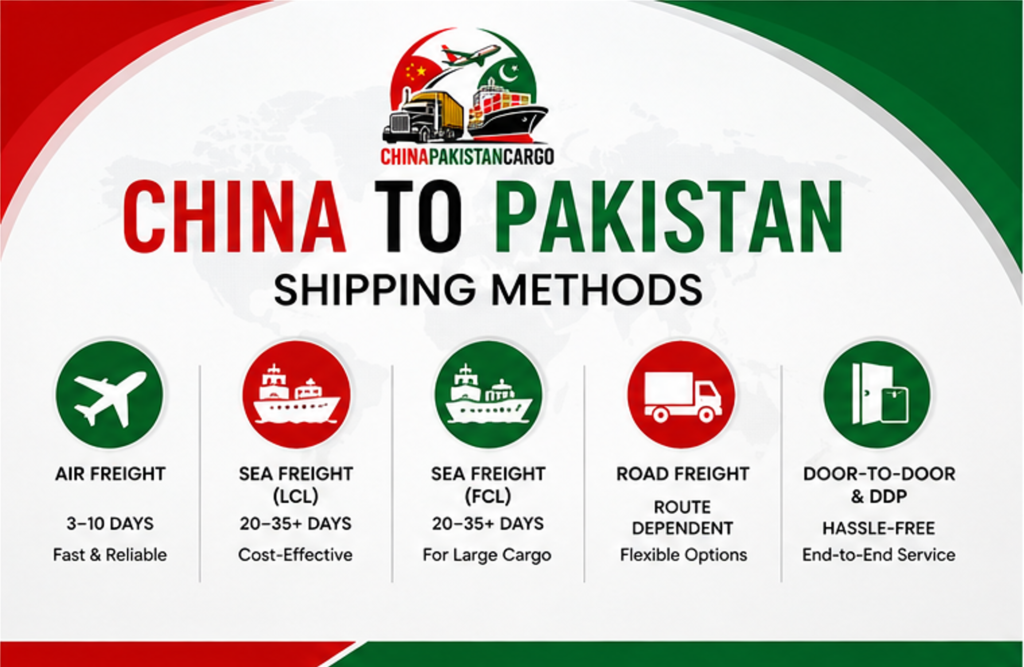
Let’s compare the main options.
Air Freight from China to Pakistan
Air freight is generally the best option when speed is more important than obtaining the lowest possible transportation cost.
It is commonly used for:
- Electronics
- Mobile accessories
- E-commerce inventory
- Samples
- Fashion products
- Spare parts
- Industrial components
- Urgent factory supplies
- Lightweight commercial goods
- High-value cargo
China Pakistan Cargo provides dedicated Air Cargo from China to Pakistan covering supplier pickup, air transportation, customs support and delivery options.
Advantages of Air Cargo
Air freight offers:
- Faster transportation
- Quick inventory replenishment
- Suitability for urgent shipments
- Good economics for some lightweight/high-value products
- Lower inventory transit time
Its main disadvantage is cost.
Heavy or bulky products can become expensive to transport by air.
How Air Freight Charges from China to Pakistan Are Calculated
A common mistake is assuming that a shipment weighing 100 kg will always be charged as 100 kg.
Airlines typically compare:
Actual Gross Weight
with
Volumetric Weight
The higher applicable figure becomes the chargeable weight.
A commonly used formula is:
Volumetric Weight (kg) = Length × Width × Height (cm) ÷ 6,000
The divisor can vary according to airline, carrier and service.
Air Freight Calculation Example
Suppose you have 10 cartons measuring:
60 × 50 × 50 cm
Volume per carton:
60 × 50 × 50 = 150,000 cm³
Volumetric weight:
150,000 ÷ 6,000 = 25 kg
For 10 cartons:
25 × 10 = 250 kg volumetric weight
Suppose the actual shipment weighs only:
180 kg
Because the volumetric weight is higher, the shipment may be charged based on approximately:
250 kg chargeable weight
This is why you should provide both weight and carton dimensions when requesting an air-cargo quotation.
Sea Freight from China to Pakistan
For heavy, bulky or non-urgent commercial shipments, sea freight is usually more economical than air freight.
China Pakistan Cargo provides Sea Freight from China to Pakistan with LCL and FCL options.
Major Chinese shipping areas include:
- Shanghai
- Ningbo
- Shenzhen/Yantian
- Guangzhou
- Qingdao
- Xiamen
Cargo can be routed to Pakistan through Karachi-area port infrastructure, including Karachi Port and Port Qasim, depending on the shipment and service.
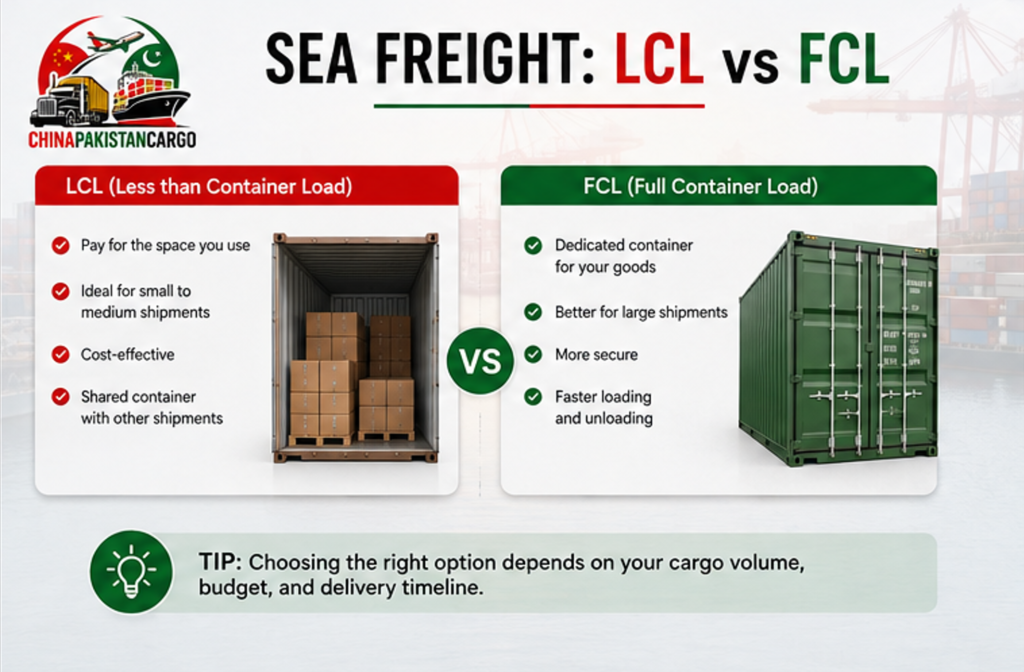
There are two main types of containerized sea freight:
LCL – Less Than Container Load
and
FCL – Full Container Load
LCL Shipping from China to Pakistan
LCL means your goods share container space with shipments belonging to other customers.
You therefore do not need to pay for an entire container.
LCL is particularly useful when shipping:
- Several cartons
- Pallets
- Small commercial orders
- Several CBM of products
- Machinery components
- Mixed supplier orders
For importers with insufficient Pakistan cargo to justify a complete container, LCL can offer a much more economical solution.
China Pakistan Cargo provides LCL shipping from China to Pakistan with supplier collection, consolidation, sea freight and Pakistan delivery options.
FCL Container Shipping from China to Pakistan
FCL means Full Container Load.
Instead of sharing container space, the importer books a complete container.
Common container sizes include:
- 20-foot container
- 40-foot container
- 40-foot High Cube container
FCL is commonly used for:
- Machinery
- Furniture
- Industrial equipment
- Auto parts
- Building materials
- Textiles
- Raw materials
- Consumer goods
- Large commercial inventory
One advantage of FCL is reduced cargo handling compared with consolidated LCL shipments.
For sufficiently large shipments, FCL may also become cheaper per cubic metre than LCL.
Explore LCL & FCL Shipping China to Pakistan for container shipping options.
LCL vs FCL: Which Is Cheaper?
| Factor | LCL | FCL |
|---|---|---|
| Small shipment | Excellent | Usually inefficient |
| Medium shipment | Often suitable | Compare both |
| Large shipment | Can become expensive | Often more economical |
| Pay for whole container | No | Yes |
| Consolidation | Required | Not required |
| Cargo handling | More | Less |
| Best suited for | Small/medium cargo | Large commercial cargo |
There is no fixed CBM point at which FCL automatically becomes cheaper.
Freight rates and destination charges change.
Once your shipment becomes relatively large, ask your forwarder to calculate both LCL and FCL before booking.
How Sea Freight Costs from China to Pakistan Are Calculated
Sea freight costs can include more than the ocean rate itself.
Depending on your quotation and Incoterm, costs may include:
- Supplier pickup
- China warehouse handling
- Export documentation
- Origin terminal charges
- Ocean freight
- LCL consolidation/deconsolidation
- Destination charges
- Customs clearance
- Duties and taxes
- Port handling
- Container-related charges
- Inland delivery in Pakistan
This is why comparing only an advertised ocean rate can give an inaccurate picture of your total shipping cost.
Always ask:
What exactly is included in this quotation?
Understanding CBM for China-to-Pakistan Cargo
CBM means cubic metre and is particularly important when calculating sea freight.
The formula is:
Length (m) × Width (m) × Height (m) = CBM
Suppose one carton measures:
0.6 × 0.5 × 0.4 metres
Volume:
0.6 × 0.5 × 0.4 = 0.12 CBM
If there are 50 identical cartons:
0.12 × 50 = 6 CBM
The shipment therefore occupies approximately 6 CBM.
Both CBM and gross weight should be provided when requesting an LCL freight to Pakistan quotation because exceptionally dense cargo can be treated differently.
Road Freight from China to Pakistan
China and Pakistan are also connected through an overland trade corridor via Khunjerab and Sost.
Road freight can provide an alternative to conventional air and sea transportation for suitable commercial cargo.
Its viability depends on factors including:
- Origin city
- Destination city
- Product type
- Shipment dimensions
- Border procedures
- Customs requirements
- Seasonal and route conditions
- Current service availability
Road freight should therefore be quoted according to the specific shipment rather than assumed to be universally faster or cheaper than sea freight.
See Road Freight China to Pakistan for available overland shipping solutions.
Door-to-Door Cargo to Pakistan from China
For many SMEs and first-time importers, door-to-door cargo to Pakistan is one of the simplest logistics arrangements.
Instead of coordinating separate companies, the logistics provider can manage the shipment from the Chinese supplier to the agreed destination in Pakistan.
A typical door-to-door shipment can include:
Supplier Pickup → China Warehouse → Export Clearance → International Freight → Pakistan Customs → Inland Transportation → Final Delivery
This option is particularly useful for:
- SMEs
- E-commerce sellers
- New importers
- Wholesalers
- Retail businesses
- Companies sourcing from multiple Chinese factories
- Businesses without an internal logistics team
Learn more about Door-to-Door Cargo China to Pakistan.
DDP Shipping from China to Pakistan
DDP stands for Delivered Duty Paid.
Under a properly structured DDP arrangement, responsibility for agreed transport and import obligations extends through to the named destination according to the agreed commercial terms.
The major advantage is convenience and potentially greater cost predictability.
Instead of separately arranging:
- China pickup
- Export handling
- International freight
- Customs clearance
- Duties and taxes
- Local transportation
the customer receives an agreed end-to-end shipping arrangement.
However, never assume every quotation labelled DDP China to Pakistan includes exactly the same services.
Before accepting a DDP quote, confirm:
- Supplier pickup
- Origin handling
- Export clearance
- International freight
- Pakistan customs clearance
- Duties and taxes
- Destination handling
- Final delivery
- Insurance
- Storage/demurrage exclusions
- Documentation
- Restricted-goods conditions
A lower headline quotation may not be cheaper if important costs are excluded.
Calculate Landed Cost — Not Just Freight Cost
Experienced importers do not make purchasing decisions using the Chinese factory price alone.
They calculate landed cost.
A simplified formula is:
Product Cost + China Logistics + International Freight + Insurance + Customs Duties & Taxes + Clearance/Handling + Pakistan Delivery = Landed Cost
Consider two suppliers:
Supplier A: Product price = $10.00/unit
Supplier B: Product price = $10.50/unit
Supplier A initially appears cheaper.
But suppose Supplier A uses oversized packaging that substantially increases CBM or volumetric weight.
After shipping, Supplier B could actually provide the lower landed cost per unit.
Procurement and logistics should therefore be calculated together.
Pakistan Customs Clearance for China Cargo
Every commercial shipment entering Pakistan must comply with applicable customs and import requirements.
Customs assessment is not based simply on cargo weight or one universal tax percentage.
Depending on the product and transaction, relevant factors can include:
- PCT/HS classification
- Customs value
- Product description
- Country of origin
- Customs duty
- Additional customs duty, where applicable
- Regulatory duty, where applicable
- Sales tax
- Income/withholding tax treatment
- Exemptions and concessions
- Valuation rulings
- Preferential tariff treatment
- Product-specific regulations
Businesses importing Pakistan cargo from China should therefore estimate customs costs before dispatching the goods.
China Pakistan Cargo provides Customs Clearance China to Pakistan support for commercial shipments.
What Is an HS Code or Pakistan PCT Code?
The Harmonized System provides an internationally standardized framework for classifying traded goods.
Pakistan’s tariff classification uses the Pakistan Customs Tariff (PCT).
The correct classification can affect:
- Customs duty
- Regulatory duty
- Additional customs duty
- Sales tax treatment
- Concessions
- Import restrictions
- Required permits
- Customs valuation
- Regulatory requirements
Products that look similar should not automatically be assumed to have the same classification.
For example:
- LED bulbs
- LED drivers
- Solar lights
- Automotive LEDs
- Decorative LED lighting
may fall under different classifications depending on their specifications and function.
A supplier’s Chinese export HS code should therefore not automatically be assumed to be the correct Pakistani PCT classification.
Verify the classification before shipping.
How Pakistan Customs Determines Import Value
Another important concept is customs value.
Importers sometimes assume:
Supplier Invoice = Customs Value
That is not necessarily correct.
Under Section 25 of Pakistan’s Customs Act, transaction value is the starting point where the statutory conditions for acceptance are satisfied.
Applicable additions can include costs such as transportation to the place of importation, associated loading/unloading/handling and insurance when these are not already included.
As a simplified illustration:
Product invoice: $10,000
International freight: $1,500
Insurance/other applicable additions: $100
The customs calculation should not automatically be modeled solely on the $10,000 supplier invoice.
The applicable valuation method, classification, customs exchange rate and other requirements need to be considered.
FBR Valuation Rulings and Why They Matter
Pakistan Customs may issue valuation rulings covering particular categories of imported goods.
Where an applicable ruling exists, it can materially affect the customs valuation of your shipment.
Before importing, check:
- Correct PCT code
- Current tariff
- Applicable valuation ruling
- Customs duty
- Regulatory duty
- Additional customs duty
- Sales tax
- Income tax treatment
- Available exemptions
- Preferential tariff eligibility
This should ideally happen before placing the final purchase order, not after the shipment reaches Pakistan.
A product that appears profitable at its Chinese factory price may have a very different margin after customs and logistics costs are included.
Pakistan Single Window and Import Declarations
Pakistan has digitized significant parts of its cross-border trade process through Pakistan Single Window (PSW).
Its Single Declaration system provides an electronic interface for import declarations and can route relevant information to government agencies involved in clearance.
Depending on the commodity, additional regulatory requirements can apply.
Products involving areas such as:
- Food
- Plant material
- Animals
- Pharmaceuticals
- Chemicals
- Product standards
- Telecommunications equipment
- Other controlled commodities
may require additional permissions, certificates or regulatory processing.
Always establish whether the product can legally be imported and what documents are required before the cargo leaves China.
Documents Required for Shipping from China to Pakistan
Documentation requirements vary according to the commodity and transaction, but common commercial shipping documents include:
Commercial Invoice
Normally contains:
- Seller information
- Buyer information
- Product description
- Quantity
- Unit price
- Total value
- Currency
- Relevant commercial terms
Packing List
Typically shows:
- Number of cartons
- Packaging
- Gross weight
- Net weight
- Dimensions
- Product quantities
Bill of Lading
Used for sea freight shipments.
Air Waybill
Used for air freight shipments.
Certificate of Origin
May be required where applicable, including when claiming certain preferential tariff treatment.
Product-Specific Documentation
Depending on the commodity, additional documentation can include:
- Licences
- Permits
- Certificates
- Test reports
- Technical documentation
- MSDS for relevant goods
- Regulatory approvals
Confirm these requirements before shipment.
China-Pakistan FTA and Preferential Customs Duties
China and Pakistan have a bilateral free-trade framework under which qualifying goods can receive preferential tariff treatment when applicable requirements are satisfied.
However:
Chinese origin does not automatically mean zero customs duty.
Eligibility depends on matters including:
- PCT classification
- Applicable tariff concession
- Rules of origin
- Origin documentation
- Current customs requirements
Importers should therefore check the specific tariff line rather than assuming every Chinese product qualifies for duty-free import.
Common Pakistan Cargo Customs Mistakes
1. Using the Supplier’s HS Code Without Verification
A Chinese export classification does not automatically establish the correct Pakistani PCT code.
Verify it independently.
2. Calculating Customs Only From the Supplier Invoice
Customs valuation can involve more than the invoice amount.
Calculate the expected customs value before importing.
3. Ignoring FBR Valuation Rulings
An applicable valuation ruling can significantly affect landed cost.
4. Using Vague Product Descriptions
Descriptions such as:
“Electronic items”
are unnecessarily vague.
A description such as:
“24V 100W LED power supply, model XYZ”
provides much clearer information.
5. Shipping Before Checking Import Requirements
Some commodities require regulatory approvals or specific documentation.
Do not wait until the cargo reaches Pakistan to investigate these requirements.
6. Comparing Only Freight Rates
A cheap ocean or air rate can become expensive after destination charges, customs clearance and inland delivery are added.
Compare total landed logistics costs.
How to Reduce Shipping Costs from China to Pakistan
Consolidate Multiple Suppliers
Combining orders from several factories into one shipment can reduce repeated logistics and handling costs.
Optimize Packaging
Oversized cartons increase CBM and volumetric weight.
Ask suppliers whether packaging can safely be reduced without compromising product protection.
Compare Air, LCL and FCL
Do not automatically use the same method for every shipment.
A 200 kg shipment and a 12 CBM shipment may require completely different strategies.
Calculate Customs Before Purchasing
Estimate:
Product + Freight + Customs + Clearance + Delivery
before paying the supplier.
Verify PCT Classification Early
Classification mistakes can dramatically affect landed cost and customs clearance.
Avoid Unnecessary Emergency Freight
Better inventory planning can reduce expensive last-minute air shipments.
Compare Complete Quotations
Do not compare one company’s port-to-port price against another company’s door-to-door price.
Make sure the service scope is equivalent.
How to Compare Pakistan Cargo Services
Choosing between Pakistan cargo services should involve more than asking:
“What is your rate per kg?”
Ask the freight company:
- Is supplier pickup included?
- Is China warehouse handling included?
- Can you consolidate multiple suppliers?
- Is export clearance included?
- What freight method will be used?
- How is chargeable weight calculated?
- Are destination charges included?
- Is Pakistan customs clearance included?
- Are duties and taxes included?
- Is final delivery included?
- Is insurance available?
- What happens if Customs examines the cargo?
- Are storage or demurrage charges excluded?
- Will I receive clearance and shipping documentation?
- What is the estimated door-to-door transit time?
A trustworthy logistics partner should make the cost structure clear before shipment.
Shipping Cargo to Karachi, Lahore, Faisalabad & Across Pakistan
International freight ends at a port or airport.
Your business supply chain usually does not.
If your warehouse is in Faisalabad, Lahore, Islamabad, Sialkot, Multan, Peshawar or another inland city, calculate logistics through to the actual destination.
For example:
Guangzhou Factory → China Warehouse → Chinese Port → Karachi/Port Qasim → Customs Clearance → Inland Truck → Faisalabad Warehouse
The ocean freight component may represent only one part of your total logistics expense.
China Pakistan Cargo provides delivery options for cargo to Pakistan across major commercial and industrial cities.
Which China-to-Pakistan Shipping Method Should You Choose?
Choose Air Freight If:
- Cargo is urgent
- Shipment is relatively small
- Product value per kg is high
- You need rapid inventory replenishment
- Production depends on urgent components
Choose LCL Sea Freight If:
- Air freight is becoming too expensive
- You do not have enough cargo for a full container
- Delivery is not urgent
- The goods are relatively bulky
Choose FCL If:
- Shipment volume is large
- You regularly import commercial quantities
- Reduced cargo handling is important
- FCL economics are better than LCL
Consider Road Freight If:
- The overland route suits your origin and destination
- The cargo is suitable
- Current route conditions and border procedures make it practical
Choose Door-to-Door or DDP If:
- You want one logistics provider managing the shipment
- You prefer simplified coordination
- You require delivery to your warehouse
- You want greater visibility of the complete logistics cost
Why Choose China Pakistan Cargo?
China Pakistan Cargo specializes in logistics between China and Pakistan and provides services for businesses ranging from small importers to commercial shippers.
Our Pakistan cargo services include:
- Supplier pickup in China
- Cargo consolidation
- Air freight
- Sea freight
- LCL shipping
- FCL container shipping
- Road freight
- Customs clearance
- Door-to-door cargo
- DDP solutions
- Commercial cargo
- E-commerce cargo
- Delivery across Pakistan
Explore our services:
Air Cargo from China to Pakistan
For urgent, lightweight and time-sensitive commercial shipments.
Sea Freight from China to Pakistan
For economical transportation of heavier and larger cargo.
LCL & FCL Shipping China to Pakistan
For shared-container and full-container shipments.
Door-to-Door Cargo China to Pakistan
For complete supplier-pickup-to-destination logistics.
Customs Clearance China to Pakistan
For customs documentation, classification and clearance support.
Road Freight China to Pakistan
For suitable overland commercial shipments.
FAQs About Shipping from China to Pakistan
How much does shipping from China to Pakistan cost?
The cost depends on cargo weight, volumetric weight, CBM, product type, origin, destination, shipping method, current carrier rates and customs requirements.
An accurate quotation requires your product description, weight, carton dimensions, CBM, pickup location and delivery city.
What is the China to Pakistan cargo price per kg?
There is no single price per kg applicable to every shipment. Air freight is normally based on chargeable weight, while sea freight calculations depend more heavily on cargo volume, weight, container requirements and applicable origin/destination charges.
What is the cheapest way to send cargo to Pakistan from China?
For larger and non-urgent commercial shipments, sea freight is generally more economical than air freight. LCL can work well for smaller volumes, while FCL can become more economical for large shipments.
What is the fastest way to ship from China to Pakistan?
Air freight is generally the fastest conventional commercial freight to Pakistan for urgent shipments.
How long does shipping from China to Pakistan take?
Transit time depends on the method and route. Air cargo can take several days, while sea freight commonly takes several weeks. Customs processing, consolidation and final delivery need to be considered in addition to port-to-port or airport-to-airport transit.
Can I ship less than one container from China to Pakistan?
Yes. LCL shipping allows your cargo to share container space with other shipments, so you do not need enough goods to fill an entire container.
What documents are required for Pakistan cargo?
Common documents include a commercial invoice, packing list, Bill of Lading or Air Waybill, plus any applicable certificate of origin and product-specific regulatory documentation.
How is Pakistan customs duty calculated on Chinese goods?
Customs treatment depends on factors including PCT classification, customs value, applicable duties and taxes, valuation rules, concessions and regulatory requirements.
Does the China-Pakistan FTA mean imports from China are duty-free?
No. Preferential tariff treatment depends on the specific tariff line, applicable concession, rules of origin and required documentation.
Can I combine goods from multiple Chinese suppliers?
Yes. Supplier consolidation allows goods from different factories to be collected at one warehouse and combined into a single shipment where appropriate.
Can China Pakistan Cargo deliver directly to my warehouse?
Door-to-door services can cover supplier pickup, international transportation, Pakistan customs clearance and delivery to the agreed destination.
Is air freight or sea freight better from China to Pakistan?
Air freight is better when speed is the priority. Sea freight is generally better for heavy, bulky and non-urgent cargo. The best option should be determined by comparing weight, CBM, cargo value, urgency and landed cost.
Get a China-to-Pakistan Shipping Quote
The best freight to Pakistan solution is not necessarily the company offering the lowest advertised price per kg.
A successful import shipment requires the right combination of:
Freight Cost + Transit Time + Customs Compliance + Cargo Safety + Reliable Clearance + Predictable Landed Cost
Whether you are shipping several cartons, a few CBM, machinery, commercial inventory or a full container, China Pakistan Cargo can help you compare air, sea, LCL, FCL, road and door-to-door options.
Before requesting a quotation, prepare:
- Product name and description
- Number of cartons
- Gross weight
- Carton dimensions
- Total CBM
- Pickup city in China
- Delivery city in Pakistan
- Commercial value
- PCT/HS code, if available
Get a China-to-Pakistan shipping quote and compare the most suitable freight solution before dispatching your cargo.
About China Pakistan Cargo
China Pakistan Cargo is a specialized logistics company providing reliable shipping from China to Pakistan for businesses, importers, wholesalers, and e-commerce sellers. We offer complete Pakistan cargo services, including supplier pickup and consolidation in China, air freight, sea freight, LCL and FCL shipping, road freight, customs clearance, and door-to-door delivery across Pakistan. With logistics support in both China and Pakistan, we focus on transparent pricing, efficient cargo handling, customs compliance, and dependable delivery from your supplier to your final destination.